

ROBOTICS & INTELLIGENT AUTOMATION
From Intelligent Machines
to Real-World Applications
Robotics is evolving beyond traditional automation, combining mechanical systems, advanced sensors, artificial intelligence, machine perception, and intelligent control. From industrial robotic arms and autonomous mobile robots to humanoid robots designed to operate in human environments, different technologies offer different capabilities, limitations, and opportunities. Selecting the right solution requires understanding the task, operating environment, required level of autonomy, safety requirements, and commercial objectives. At Rehberium, we approach robotics from both a technology and business development perspective, connecting innovative solutions with relevant applications, customers, partners, and market opportunities in Türkiye.

Additive Manufacturing is no longer limited to rapid prototyping. It has evolved into a broad group of industrial production technologies capable of producing complex, lightweight, customized, and functional parts across polymers, metals, composites, and other advanced materials. The right technology, material, design strategy, and post-processing route must be considered together to achieve the required performance, quality, cost, and production volume. At Rehberium, we look at Additive Manufacturing from this complete technical and commercial perspective—connecting technologies, materials, applications, and business opportunities.

Understanding the
Robotics Landscape
Robotics is not a single technology. It is an ecosystem of machines, software, sensing systems, control technologies, and application-specific solutions.
Industrial robots are widely used for tasks such as welding, material handling, assembly, painting, and machine tending. Collaborative robots are designed to support flexible automation in applications where people and robots may work in close proximity, subject to appropriate risk assessment and safety measures.
Autonomous mobile robots (AMRs) navigate dynamic environments to support material movement and intralogistics. Service robots perform specific tasks in settings such as commercial buildings, hospitality, cleaning, and inspection.
Humanoid robots represent an emerging category designed around human-like body structures and the ability to operate in environments built for people. Their potential applications include selected material-handling, inspection, and other task-based operations. However, their practical capabilities and economic value must be assessed for each application.
The key is not to choose the most advanced-looking robot. It is to identify the technology that can perform the required task safely, reliably, and economically.


Humanoid Robots: From Human-Like Design to Practical Applications
Humanoid robots are designed with a human-like body structure, typically incorporating a torso, arms, hands, and, in many cases, two legs. This design aims to make it possible for robots to operate in environments originally built for people, potentially reducing the need to redesign existing workplaces.
Their capabilities depend on the integration of several technologies. Actuators and control systems enable movement, sensors provide information about the surroundings, computer vision supports object and environment recognition, and robotic hands enable interaction with tools and objects. Artificial intelligence can help robots interpret tasks, respond to changing conditions, and coordinate actions.
Potential applications include moving materials, handling selected objects, performing repetitive tasks, supporting inspection activities, and assisting with certain operations in manufacturing and logistics. The suitability of a humanoid robot depends on its payload, manipulation capability, mobility, operating time, task reliability, and ability to work safely in the intended environment.
Humanoid robotics is developing rapidly, but technical demonstrations should not be confused with proven industrial performance. Some applications remain at the pilot or development stage, and certain systems rely on remote human assistance for parts of their operation. Battery life, maintenance, safety, repeatability, and total cost of ownership remain important considerations.
At Rehberium, we focus on understanding where humanoid robotics can create practical value, identifying potential industrial applications, and connecting technology providers with customers and business partners in Türkiye.


Industrial Robotics & Collaborative Automation
Industrial robotics has become an established part of modern manufacturing, supporting operations that require consistency, precision, productivity, and repeatability. Robotic systems are used across automotive manufacturing, metal processing, electronics, packaging, food production, and many other industrial sectors.
Common applications include robotic welding, machine tending, pick-and-place operations, assembly, material handling, palletizing, painting, and inspection. Depending on the application, robots may operate as standalone machines or as part of integrated production cells connected to conveyors, sensors, machine tools, vision systems, and manufacturing software.
Collaborative robots, commonly known as cobots, offer additional flexibility for selected applications involving frequent product changes, smaller production batches, or close interaction between workers and automated equipment. However, collaborative operation is not automatically safe simply because a robot is designated as a cobot. The complete application must be assessed, including tools, workpieces, speed, forces, and the surrounding environment.
The right robotic solution depends on cycle time, payload, reach, accuracy, repeatability, production volume, integration requirements, and total operating cost.
Rehberium helps robotics providers identify relevant industrial applications, potential customers, and commercial partners in Türkiye.
Autonomous Mobile Robots
& Intelligent Material Handling
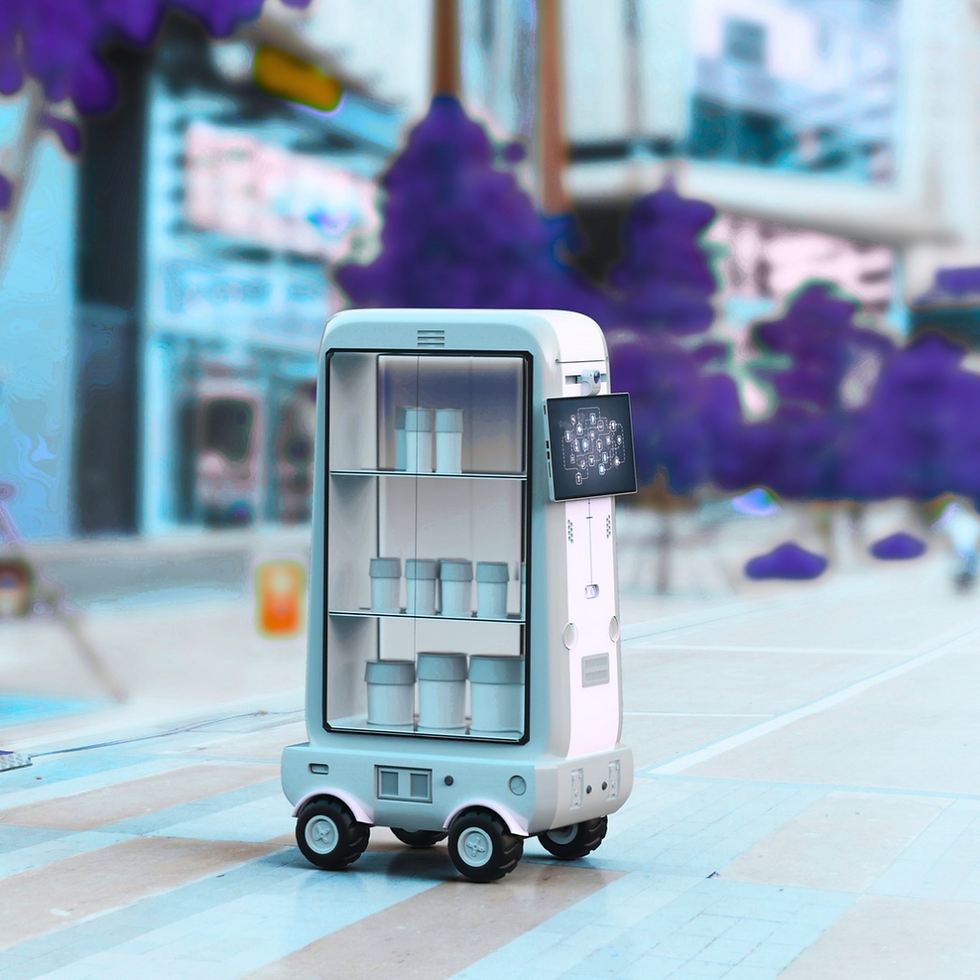
Autonomous mobile robots are designed to transport materials, components, products, and other loads through industrial and commercial environments. Unlike conventional fixed conveyor systems, mobile robots can offer greater flexibility when routes, layouts, and operational requirements change.
In manufacturing, these systems can support the movement of components between workstations, supply production lines, and connect different stages of the manufacturing process. In warehouses and distribution facilities, they can assist with internal transportation, order fulfilment workflows, and material flow management.
Effective deployment requires more than the robot itself. Navigation technology, mapping, obstacle detection, fleet management, traffic coordination, charging infrastructure, and integration with warehouse or manufacturing systems all influence performance.
Application assessment should consider payload, travel distance, floor conditions, traffic density, required throughput, charging strategy, and interaction with people and other equipment.
Rehberium supports the commercial development of mobile robotics solutions by helping technology providers identify suitable customers, potential integration partners, and business opportunities in Türkiye.



AI, Machine Perception & Intelligent Control
Modern robotics combines physical machines with software that helps them perceive their surroundings, interpret information, and execute tasks. Cameras, depth sensors, force and torque sensors, encoders, and other sensing technologies provide data about the robot, its environment, and the objects it interacts with.
Machine vision can support object recognition, positioning, inspection, and quality control. Motion planning and control systems determine how a robot moves, while artificial intelligence can help interpret instructions, adapt to variations, and coordinate more complex tasks.
In humanoid robotics, the integration of perception, balance, locomotion, manipulation, and task planning is particularly important. A robot must not only identify an object but also understand how to approach it, grasp it, manipulate it, and respond when conditions change.
The performance of an intelligent robotic system depends on the quality of its sensors, software, training data, control architecture, computing resources, and integration with the target application. Greater autonomy does not eliminate the need for testing, monitoring, or appropriate safety measures.
Understanding these elements helps businesses assess whether a robotic solution is suitable for a specific operational requirement.
From Demonstration to Deployment: What Really Matters
A successful robotics demonstration does not automatically translate into a commercially viable application. Real-world deployment requires a clear understanding of the task, operating conditions, performance expectations, and the cost of running the system over time.
Several factors must be evaluated:
-
Task reliability: Can the robot complete the task consistently across repeated cycles?
-
Autonomy: Which activities are performed independently, and where is human intervention required?
-
Productivity: Does the system meet the required cycle time and throughput?
-
Manipulation: Can the robot handle the required objects, tools, and variations in position or shape?
-
Safety: Can it operate safely around people, equipment, and changing environmental conditions?
-
Integration: Can it communicate and operate effectively with existing machines, software, and workflows?
-
Maintenance: What support, spare parts, software updates, and technical expertise are required?
-
Economics: Do the expected operational benefits justify the investment and ongoing costs?
For humanoid robots in particular, operating time, reliable manipulation, recovery from errors, and the level of remote assistance should be examined carefully.
A structured assessment helps businesses distinguish between an impressive demonstration, a promising pilot project, and a solution ready for repeatable commercial deployment.


Choosing the Right Robotics Solution
Selecting a robotics solution should begin with the operational requirement, not with a particular robot model or technology.
The first step is to define the task: what needs to be moved, handled, inspected, assembled, or automated? The next step is to evaluate the environment, including available space, floor conditions, existing equipment, worker interaction, and process variability.
Technical requirements such as payload, reach, speed, accuracy, mobility, manipulation capability, and operating time must then be matched to the application. Software compatibility, integration complexity, safety requirements, maintenance, and technical support are equally important.
The business case should consider the complete cost of ownership, including equipment, integration, training, maintenance, consumables, downtime, and future scalability. Where technical or economic uncertainty remains, a carefully defined pilot project can help validate performance before a larger deployment.
Rehberium helps businesses approach robotics opportunities with a clear view of the application, the relevant technology providers, and the commercial requirements of the project.
Where Robotics & Intelligent Automation Create Value
Robotics and intelligent automation can support a wide range of industrial and commercial applications. The most suitable solution depends on the task, operating environment, and required level of performance.
Manufacturing & Automotive
Robotic welding, assembly, machine tending, material handling, inspection, and selected repetitive production tasks.
Logistics & Warehousing
Autonomous material transportation, warehouse workflows, internal logistics, and selected picking or handling operations.
Metalworking & Industrial Equipment
Machine tending, part handling, inspection, and automation of repetitive processes.
Electronics & Precision Manufacturing
Small-part handling, inspection, assembly support, and selected high-repeatability operations.
Commercial & Service Environments
Reception, information, guidance, cleaning, and other clearly defined service tasks.
Inspection & Hazardous Environments
Robotic systems designed to inspect equipment or operate in environments where human access may be difficult or undesirable.
Humanoid robots may be relevant where human-like mobility and manipulation offer practical advantages. In other situations, a conventional industrial robot, cobot, or autonomous mobile robot may provide a more suitable and economical solution.


How Rehberium Supports Robotics & Automation Businesses
Rehberium helps international robotics and automation companies identify business opportunities, develop commercial relationships, and explore the Turkish market. We work across emerging and established robotics technologies, connecting solution providers with potential customers, distributors, integration partners, and relevant industrial stakeholders.
For international technology providers, our support can include:
-
Market research and identification of relevant industry segments
-
Potential customer identification and lead generation
-
Distributor and integration partner search
-
Local business development and commercial communication
-
Customer follow-up and relationship development
-
Identification of potential pilot projects and application opportunities
We also help Turkish companies explore international robotics technologies, identify potential suppliers and technology partners, and connect with manufacturers whose solutions match their operational requirements.
Our approach combines market understanding, technical awareness, and hands-on business development. We focus on identifying the right opportunities and building the relationships needed to move from initial interest to meaningful commercial discussions.
From humanoid robot manufacturers and industrial robotics providers to mobile robot developers, automation companies, and system integrators, Rehberium helps connect technologies with the customers and partners that can bring them closer to the market.
Let's Build Your Robotics Opportunity in Türkiye
Whether you develop humanoid robots, industrial robotic systems, autonomous mobile robots, service robots, or AI-powered automation solutions, Rehberium can help you identify relevant customers, partners, and business opportunities in Türkiye. Let's explore how we can bring your technology closer to the right market.